
Traffic Warrants in Lea County
Traffic cases in Lea County live in specific courts, so warrant answers are court-specific too. The New Mexico Courts Case Lookup covers traffic categories and lets you search by citation or case number. Still, the public portal is not a warrant register. A citation usually carries a payment date or an arraignment date. Miss it, or fail to pay, and the court's process can turn that into a criminal summons, a bench warrant, or both. City traffic matters belong to the municipal court named on the citation, while magistrate courts handle separate DWI and traffic cases. When you are unsure what you are holding, ask the court clerk directly. The clerk can tell you whether your issue is a citation, a summons, a bench warrant, a license-related notice, or something else.
- Read the court name, citation number, and payment or arraignment date.
- Use Case Lookup with the court, name, citation, or case number fields.
- Call the issuing clerk if the result is missing, unclear, or shows a warrant event.
- Ask whether proof, payment, appearance, bond, or a motion is required.
- Keep the court’s written confirmation after the matter changes.
Hobbs Traffic Warrants in Lea County
Hobbs offers the most detailed traffic workflow in Lea County. Its court page explains that citations come with a due date or a traffic arraignment date, and that failing to pay or appear can bring a criminal summons and/or a bench warrant. If your matter qualifies for the Traffic Violations Bureau, you may resolve it in person, by phone, online, or by mail. The Hobbs Municipal Court sits at 301 N. Turner Street, Hobbs, NM 88240, and its listed number is 575-397-9272. Posted hours run Monday through Thursday, 7:30 a.m. to 5:30 p.m., and Friday, 8 a.m. to noon. Call ahead to confirm before you drive over. For the official court source, the Fifth District homepage posts the court's own traffic information and calendars.
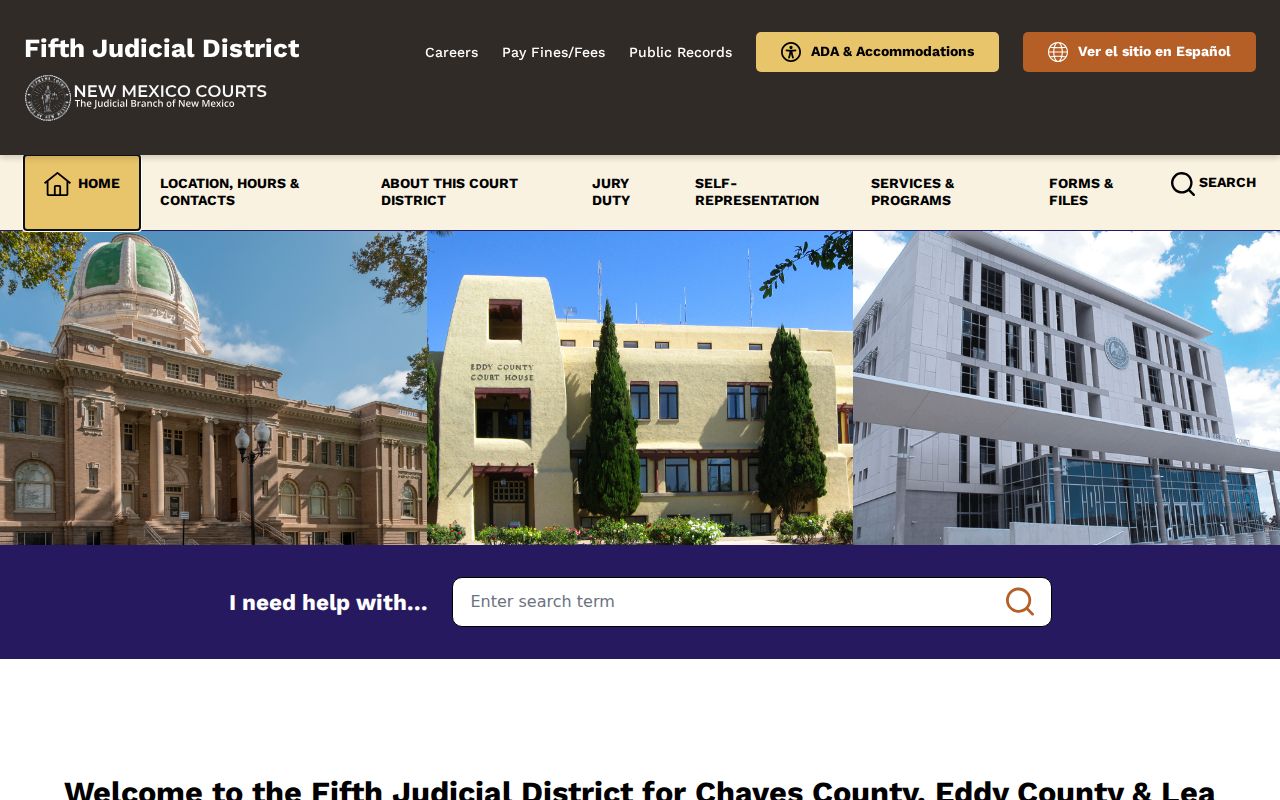
Stick with that kind of official court page for anything serious. Remember that Hobbs rules govern Hobbs cases only, not Lovington, Eunice, Jal, Tatum, or magistrate matters elsewhere in Lea County.
How to Check for a Lea County Traffic Warrant
A Lea County warrant check starts with the Case Lookup search tools. You can search by party name, date of birth, driver license and state, case number, citation number, attorney, court type, court location, category, and filed-date range. Use the citation or case number whenever you have it. A name-only hit can mix together different people. Also, an online result is not the official record. When your traffic case does not appear, call the court named on the paper, because a municipal record may not be complete in the statewide view. One more caution: even after a payment clears, a pending proof item or court condition can still remain.
| Search clue | Best use | Follow-up |
|---|---|---|
| Citation number | Locate a traffic filing | Confirm with the issuing court |
| Case number | Separate similar party names | Read the court category |
| Court location | Choose municipal or magistrate route | Call that clerk |
| Date and status | Find an event or appearance | Ask if a warrant event is current |
What a Lea County Traffic Warrant Shows
A traffic warrant record in Lea County can show a lot. Expect the court, the citation or case number, the violation or obligation, and the event date. It may also list the failure-to-appear or payment trigger, the judge, bond or release terms, and later service or recall information. Some entries never display online, so a court clerk can explain the exact public field for your case.
| Citation or case | The identifier that keeps the traffic record tied to the right court. |
|---|---|
| Appearance event | Payment due date, arraignment date, notice, or missed setting. |
| Warrant event | Bench or FTA process recorded by the issuing court. |
| Resolution status | Proof, payment, appearance, recall, cancellation, or another court action. |
Lea County Traffic Warrants: Search and Payment
Hobbs runs an online portal for eligible citation payments, taking Visa, Mastercard, and Discover. The portal excludes cash bonds, dismissal requests, contested cases, several under-18 matters, alcohol, controlled-substance, safety-course, deferred, Teen Court, and extension cases. Be aware that an online plea or payment may be reported as a conviction. The portal itself tells you when court contact is required instead. Those limits show why a payment button is not a warrant-clearance button. Lovington, Eunice, Jal, and Tatum each run separate municipal channels in Lea County. Tatum links to TatumTix, and Jal publishes a payment and contact portal. Neither receipt proves a court recalled the warrant.
Lea County Traffic Warrant Court Routes
The Fifth District gives magistrate courts jurisdiction over DWI and traffic. Municipal courts handle city ordinances and municipal traffic. The court named on your citation sets the route. In Lea County, the municipal courts in Hobbs, Lovington, Eunice, Jal, and Tatum each keep their own records. A city traffic warrant may not show through the county Sheriff or a statewide screen, so go to the issuing court.
Lea County traffic court map
Magistrate contacts: Eunice, Hobbs, and Lovington
City contacts: Hobbs, Lovington, Eunice, Jal, and Tatum
One more Lea County wrinkle: the Fifth District page lists Jal Magistrate Court as closed, with questions routed to Eunice. Confirm before you travel to an old address.
Paying or Lifting a Traffic Warrant
Call the clerk first and ask what actually clears the warrant. The fix may be payment, proof of insurance or registration, a new court date, bond, a motion to recall, or another step the judge directs. Hobbs lists proof options for eligible traffic matters. The court still has to accept and record that proof before the case counts as resolved. Lea County has no countywide traffic-warrant recall fee, so confirm any fee with the issuing court outside Hobbs.
Payment settles only the financial obligation it covers unless the court says otherwise. It does not automatically settle a bench warrant, an appearance requirement, or another condition.
Lea County Traffic Warrant vs FTA and License Holds
These are four different record questions, and mixing them leads people wrong. A traffic citation is one thing. A failure-to-appear event is another. A bench warrant is a third. A license-related hold sits with the motor-vehicle agency, not the court file. Case Lookup may show the Lea County court case yet still leave agency actions invisible, so ask the court to explain what actually happened on the date in question. A warrant page is not a driving-history report. It cannot tell you about insurance, points, or license status. When the problem runs through the New Mexico motor-vehicle process, ask the issuing court which official rescission or compliance form applies. The Court Operations forms list includes MVD FTA rescission references, but only the court can tie the right form to your particular case.
Safe Resolution for a Lea County Traffic Warrant
Lea County's January 2026 alert is blunt. Law enforcement will not call you about a warrant, ask for personal or financial details, or demand payment over the phone. Someone pressing you by phone is not the court. Type the city or court's address into your browser yourself, and call the court named on the citation for a real answer. If a warrant is active or the consequence is unclear, a lawyer can sort it out fast. After any court action, keep your receipt, proof, or docket entry. Ask the court when its records and any law-enforcement system will update, since a public index can lag behind what the judge just did.
When a Traffic Search Needs the Sheriff
A municipal traffic citation rarely starts with the Sheriff. Lea County's Sheriff answers IPRA requests only for records the agency itself holds, like a specific warrant return. So name the record you want. Ask plainly and skip sweeping person-level lists. For someone in custody, the Lea County Detention Center is a separate channel. Its roster will not tell you the traffic court, the warrant type, or bond conditions. Keep those questions apart, and each office can answer for what it truly holds.